

Whether we realize it or not, each community has a web of stories that set the stage for deeper connections. Maybe the stories center around the place they live, the identities they hold, or the values they champion. But stories aren’t always as empowering or as connective as we would like to think. In this short article, together we explore how some stories have a way of breaking down community connection, even as they claim to strengthen it.
Connect or Divide: A Double-Edged Sword
I remember this summer, I was on a spree of meeting new people. I wanted to expand my comfort zone! On this adventure, I spoke to a man about the power of stories. He claimed to be on a quest to find the stories that aren’t yet told, as a way to deepen his personal understanding of self. It reminded me immediately of the Vibrant Systems article I’d posted just a month before, The Stories We Tell!
His interest was personal – spiritual. It related deeply to the ways that Sallie Nichols interwove Jungian psychology with the journey through the Tarot’s major arcana in her book Jung and Tarot: An Archetypal Journey. In fact, the use of archetypes, myths, and stories to make sense of one’s own struggles is very common (even if we aren’t consciously choosing to understand ourselves through reading The Hunger Games).
However, in the midst of the conversation, all I could wonder aloud was, “Well how diverse are the authors you read? Are you reading stories from marginalized communities? Are you listening to the perspectives of those who have been actively silenced in history?”
And that was where the conversation died off.
Stories Are Not Inherently Connective
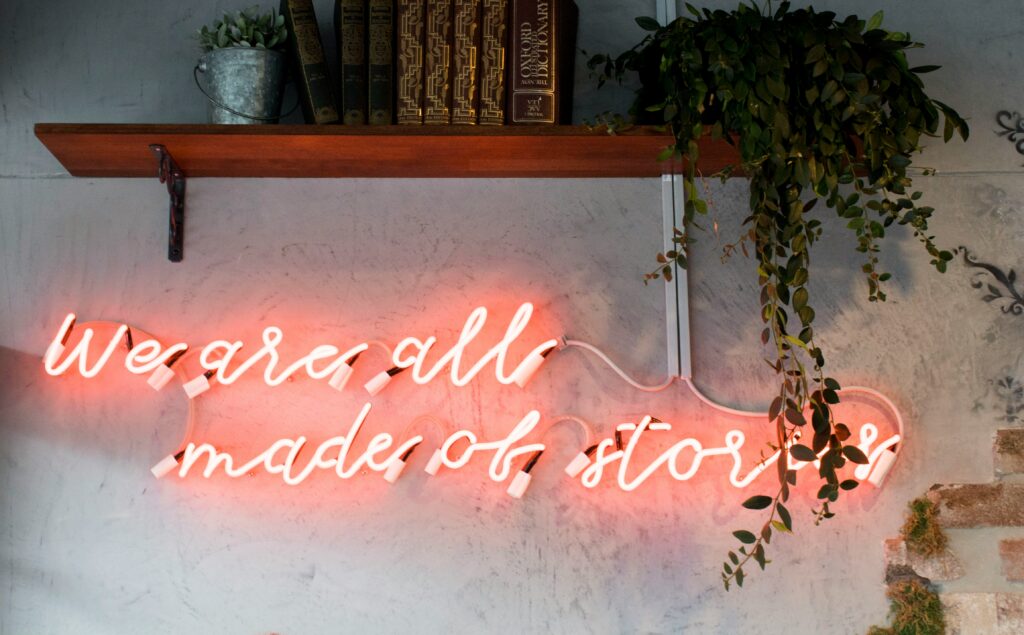
Or at least, stories do not automatically transcend the divisions that exist around us.
It is true that those who resonate with a certain narrative may be drawn towards one another, but there is no guarantee they’ve perceived the narrative the same way.
This is because we all have a different perspective – a different lens – that the story must travel through. While a book or article is full of meaning in its own right, the making of meaning gets refracted through a person’s life experience like light gets refracted through a prism.
If we’re lucky, maybe we see rainbow. Something that reflects the diversity and richness of that story.
But we don’t always see a prism. Sometimes the narrative passes through, maybe it bends a little. But often, the nuance is lost.
Whether the stories we consume shine a full spectrum rainbow or simply bend a little depends on how openly and critically we choose to engage the narrative. I’ve written before about the ways that discomfort can lead us to tune out important messages.
Whether we are reading a book or listening to someone speak, stories that make us uncomfortable are easy to dismiss. As humans, we don’t like being uncomfortable. It’s natural to reject things that make us feel icky. BUT, need I quote Buckley’s? Just because something “tastes awful”, that doesn’t mean it isn’t valuable medicine.
(Important Note: I used Buckley’s shortly after writing this article. Nobody told me it just takes like eucalyptus, and I’d been fighting using it for YEARS! What gives?)
Some Stories Consciously Divide Under The Guise Of Connection
One of the most powerful skills we have is our ability to curate and share knowledge for generations. Whether through powerful oral histories, such as we see from the Indigenous peoples of Australia, or extensive written and archeological records as we have in Egypt. This skill is also what has allowed us to gather scientific knowledge for well over a thousand years.
But naturally, uncertainty exists in these stories. Many perspectives have been silenced or erased. Processes like colonization and patriarchy often sought to override Indigenous wisdom, or that of medicine women and midwives.
This uncertainty needs to be recognized. If we don’t recognize it, this same uncertainty is where narratives can be weaponized. Then we experience stories of division rather than connection.
![How Fascism Works by Jason Stanley [cover art]](https://vibrantsystems.ca/wp-content/uploads/2025/11/How-Fascism-Works.jpg)
In Jason Stanley’s, How Fascism Works, the “mythic past” is one of the primary tools used to create a sense of connection beneath a fascist regime. This past becomes homogenized, erasing diverse intercultural influences. The nation’s history becomes sanitized, denying the violence they contributed to. Or this violence becomes glorified, attached to binary versions of female and male roles. Those who were dominated by this violence become an easy scapegoat for modern day problems.
This alternative history is a myth – but it is an alluring one. As I mentioned earlier, we humans have a tendency to avoid uncomfortable realities. Most countries, and Canada is no exception, have a fairly bloody history. Things like Reconciliation seek to navigate the uncomfortable stories of our past as a way to connect. The mythic past, on the other hand, is much more comfortable (if your past is the one being glorified).
Add repetitive and simplistic propaganda campaigns, and the stories stick with even the most well-meaning of us.
Systematically sow distrust of researchers, scientists, and historians, and suddenly the uncertainty becomes a rich ground for lies to grow. After all, those who have dedicated their lives to gathering information, checking its validity (and having its validity checked and critiqued by other researchers) MUST be lying.
And for what? Why does a fascist regime create distrust of academic institutions? Because it is these institutions who have the knowledge and evidence to refute their claims. Not just their claims of the “mythic past” and its glory, but that their dominance and control is truly in the best interest of the people they claim to serve.
Stories As A Tool To Connect Instead
To be clear, I am not suggesting we throw storytelling out the window entirely!
Stories are a way to learn, expand, and explore. They do create spaces to connect in meaningful and transformative ways. They also help us connect to ourselves and understand our inherent complexity in new and meaningful ways.
Stories shared within families can help grandchildren feel connected to ancestors who have passed away. In this way, they create a sense of belonging that extends well beyond this lifetime.
How we share (and receive) stories of hardship or pain is a healing practice. Group therapies are often used as a place where people can make meaning of the struggles they’ve faced.
On a community-level, stories are the threads that weave a tapestry of connection and shared identity. In this way, the diversity and interconnection of our stories create something beautiful. This beauty relies on incorporating the difficult stories with the joyful ones – the interweaving of the light and the dark.

The Capacity To Connect Through Stories
So how do we create spaces to connect through stories that are open to honouring the “dark” alongside the “light”? How do we honour “truth” in community, while accepting that each person’s perspective holds a piece of that truth?
If it feels overwhelming, I invite you to take a breath.
If we really want to create space for both truth and connection to emerge, we need to be prepared to sit with discomfort. That includes the discomfort that comes from having our perspectives challenged by someone else. That includes the discomfort from the realization that we’ve unintentionally harmed another person in our community.
It also means developing a capacity and a willingness to engage with a broader societal reality. It’s not enough to accept that “I have my perspective, they have their perspective, and both are equally valid”.
Our perspectives guide our choices, our values, and what we support.
Our choices are not made in a vacuum. They impact the community around us.
If we listen to a powerful story that broadens our perspective and sense of connection, but we go on to support policies or legislations that actively perpetuate harm, have we actually connected?
A Case Study In Connection

There is ample public health evidence documenting the societal value of herd immunity. It is the number one defense we have against disease for people with compromised immune systems, young children, and the elderly.
Vaccination is an individual choice. However, the choice to remain unvaccinated affects more than just ourselves.
Compelling stories about individual choice, natural immunity, and idealized health create a myth that if we just take better care of ourselves, we have nothing to fear from contagious illnesses. If we eat right, exercise right, and use the right herbal concoctions, we can’t get sick. In this myth, the people who do get sick just didn’t take good enough care of themselves.
However powerful, this story neglects the documented history we have of diseases like smallpox, diphtheria, and even measles. Through vaccination, we’ve eradicated smallpox! We’ve also dropped childhood mortality, a huge factor in our increased collective life spans.
And yet, in places like Alberta, Canada, we are losing our measles elimination status due to a misguided belief that vaccination is not only ineffective but a violation of rights and freedoms.
Now, my question is this: if you are sitting with a person who is living with a disability, and they tell you that herd immunity could be the difference between life and death for them during flu season, will you get the jab?
What if they were a close friend? A family member? What if they were your own child?
How connected are you to that person? Did you actually hear and empathize with their struggles? If you did, and you felt their fear and frustration, could you just walk away and continue to see vaccination as a choice resting solely on individuals?
Vibrant Systems Uses Stories To Connect
Whatever personal experiences led you to this article, I want to thank you for making it this far.
The truth is there are two ways to connect:
- We choose stories of comfort and certainty. These are the stories that position us as the hero overcoming all odds. Good is good. Bad is bad. We don’t need to pay attention to the nuance the grey spaces demand. We connect with people who validate this comfort and certainty. Those who contradict us are making excuses, or maybe they’ve been fooled by [insert favourite conspiracy].
- We purposefully seek out the grey spaces. We allow ourselves to learn from gathered knowledge, like history and science, and we develop an understanding of the inherent complexity of the world. The answers aren’t easy (and you may wonder if there really ever IS a “right” answer), but your choices are grounded in ethics, values, and a willingness to keep learning. The goal becomes to connect to diverse perspectives as a source of grounded knowledge.
I see the draw of the first option.
Unfortunately, to maintain feelings of confidence, we need to actively push away anyone with a perspective that challenges our own. This can include marginalized communities and researchers. Anything that makes us uncomfortable can be quickly demonized or othered. The potential of reaching a brighter future is either dim or narrowly defined within the parameters of certainty.
Option 2 is not what I’d call easy.
But it is rooted in a different place. By seeking to understand the world completely, we become the prism that splits white light into a rainbow of opportunity. Yes, the answers aren’t always clear. But a willingness to hear others and having ourselves heard increases the value of all stories. And, in the complexity, opportunities emerge that would have otherwise withered.
At Vibrant Systems, we wholeheartedly embrace the second path.
Join A Practice In Being if you’d like to embrace this second path too!
Vibrant Systems Services To Support Your Rainbow Of Connection
How do we embrace this second path? By creating spaces to both share and hear the stories around us. And, by cultivating a deeper awareness of the systems we live in.
On a personal level, our ability to learn and integrate new knowledge depends on how safe we feel. Cultivating this inner sense of safety can be difficult, depending on the life circumstances we’ve navigated. Vibrant Systems seeks to support this personal connection to safety through free guided meditations and Elements of Self, a curated video course for holistic balance.
When we cultivate a personal foundation of safety, it is easier to listen to the perspectives of others and to learn new things.
This is why Vibrant Systems also strives to cultivate a deep foundation of security in A Practice In Being and Community Mentorship. I bring my interdisciplinary background to your community, as a foundation on which to build diverse perspectives and reveal emerging opportunities.
Let’s work together, and let’s make your story a vibrant one.
No responses yet