
This article starts with a question I asked myself: “What does being well-resourced look like to me?” If I were to detach from the influences and societal expectations of what a thriving lifestyle looks like, what would it actually look like for me? What I realized was that I don’t particularly care about accumulating more things or even jet-setting off to new places. Beyond the needs necessary to maintain a sense of stability, being well-resourced looked like being resourced for connection.
It looked like being able to partake in and support my local arts community. It looked like being able to travel to see family and friends. It looked like time to spend in nature without a goal or a deadline. It looked like a business network that feels like friendship as much as it feels like work. It looked like being able to take the time to do things like bake my own bread, tend to a garden, and play an active role in the food system I benefit from. It looked like learning about the systems we live in, and most importantly, how those systems intersect to treat some people better than others. It looked like spending time playing with my niece and nephew. It looked like more dancing. It looked like rest.
When I speak about wealth in terms of connection, the picture I paint may look utopian or just naive. But not too long ago–no more than a few generations–this was the norm in most communities.
Is Connection Too Good To Be True?
Is a wealth of connection–to ourselves, to our community, and even to the environment we live in–too good to be true? In current systems, it can feel like it.
How many of us are working longer hours, picking up extra jobs, and just trying to recover between shifts?
The thought of playing with a 4 and 6-year-old might feel overwhelming, exhausting, and just not feasible. Even if we love our friend and the band they play with, going to their show on a weeknight already makes you regret the next morning (besides, that $10.00 cover charge would be better spent on groceries). Cooking your meals at home sounds nice, but who has the time after working a double shift to cover the electricity bill?
We cannot ignore the fact that we live in a system where money is the dominant currency used to obtain access to goods and services. In a time where cost of living is skyrocketing, and our pockets are being scraped at every turn, it begs the question of whether anyone can be resourced for connection in times like this?
I Wasn’t Always Resourced For Connection
Let me paint you a picture.
I was at the tail-end of my master’s degree. Each day, I would drag myself through the motions of completing that days school work (and the work I needed to do for my job that day). Then, when I felt I had done enough to scrape by, I would curl up on the couch or in bed, and scroll through social media.
Food more often became something to numb myself with. Each night, I’d slip into a stupor of TV and Facebook. Things like smiling or acknowledging another person coming and going felt like lifting a boulder–almost impossible.

When my partner at the time did drag me out to go meet with friends, I’d go reluctantly, dreading the small talk. Most days, I barely even wanted to speak to my partner, let alone try and put on a facade for people who were mostly his friends.
It was around this time of my life that I had a light bulb moment: I wasn’t neurotypical. I couldn’t do these things like normal people, because I myself wasn’t “normal”. I was neurodivergent! I needed to live a slower life!
For a while, these words gave me an understanding of how to start shifting my lifestyle. But even with terms like “accommodation” and “sensory overload”, I was struggling to feel like I could ever be a part of a community.
Connection itself felt dangerous and overwhelming.
Yet somehow, I ended up running a community-focused business centred around helping people deepen connections.
So what changed?
My World Crumbled
First, my relationship disintegrated slowly before my very eyes. Cracks I’d ignored for a long time began to fracture. Four months into 2024, I was leaving my partner–for the last time.
Leaving meant moving. Gone were the days of living on my own. I was back at my parents’ house, with all the emotional baggage of feeling like a failure for having to move home at all.
Work became tenuous. Though I was fortunate to hold a remote position that allowed me to keep my job, the grant funding my position was nearing its end. I didn’t know what I’d do after. I barely knew what I’d do then.
My dad’s health plummeted. Barely a month after moving home, my dad received his cancer diagnosis. None of us knew what his treatment plan would feel like, let alone if it would be successful. My childhood home–my foundation after an already tumultuous year–also felt precarious. If he didn’t make it, what would it mean for my mom, for myself, and for the farm I grew up on?
The world felt like it was crumbling around me, and in that crumbling, I felt like I was falling apart too. Everything that had once felt solid now seemed to turn to dust, and that fracturing left a wide open void.
I had no way of knowing it at the time, but this empty space was actually freshly turned soil–an opportunity to plant seeds, and an opportunity to reconnect.
How Connection Began To Grow
Being home for my dad’s cancer treatment was a blessing I am grateful for. I look back now, and I am still in awe of how perfectly timed my move was to his diagnosis. I could help support my mom through the treatment course, and I got to spend more quality time with my dad and brother too. Through the course of his surgeries and chemotherapy, I also noticed more opportunities to see extended family.
It seemed all of us were brought together by this diagnosis, something that had felt tenuous for years before.
But connecting in this time wasn’t necessarily easy.
Emotions were large. And of course they were. We were wrestling with mortality and our sense of stability. While I am grateful that my dad is in remission now, there was no way we could know that would be the outcome.
These emotional waves were necessary though, because they opened doors to understanding and healing that hadn’t been available before.
I also found myself in a sort of bubble. Moving from the capital city back to the farm I grew up on meant I was far from my closest friends. Without a social network, I had empty time. That empty time was spent watching the start of spring, and the gentle shift of spring into summer.
While as a child I used to spend my days playing in gardens and grasslands, I’d lost this connection. This pocket of time–something I see as the gift it was–offered me the chance to restore my relationship with the earth, the seasons, and the ecosystems that supported us.
The Seed That Was Planted
It was also in this era of my life that I started Vibrant Systems, although at that time I had no idea how it would evolve and expand to what it is now.
I had been given both encouragement from my mentor that I could do work as a consultant, and the time and space I needed to build my vision from the ground up.
Over the two years since the spring that changed everything, a lot has changed. What has changed the most, however, was actually myself.
On an intellectual level, I knew I cared about connection. I had spent seven years and two degrees learning about the relationships and systems that shape our world. I had worked with communities, and witnessed firsthand how while material barriers did exist, relational barriers were the ones that kept us stuck. I knew that connections were what I was called to tend.
But I didn’t know how.
Because at this time of my life, I had forgotten what it felt like to be connected to myself. I was also still terrified of the obligations of having friends and being a part of a community, because I saw my burnout (the picture I painted earlier) as a result of these relationships.
Alongside deep recovery work and personal healing, I needed to learn to trust my capacity for connection. I needed to understand how I participated in the cycle of burnout, and take responsibility for the ways I rested. I needed to learn what it looked like for me to be resourced for connection.
Balancing Connection In Relationships
I can see with greater clarity now that the relationships and community I had built before were never established in balance. Not only did I seek people out from my own wounds, but many of the people I built relationships with were also in need of healing.
But more importantly than even that, I didn’t know how to resource myself–support, nourish, and love myself–so that I could connect from a place of balance.
It wasn’t that I was giving “too much” and not receiving enough in return.
In fact, it was that I was giving from a cup that had been emptied long ago, and I had forgotten it was my job to learn how to refill it.
The pocket of time and space I was gifted in the crumbling was really a series of lessons to remember how to fill my own cup.
When I talk about a life of connection, as I did at the start of this blog, those connections are not just me giving. They are relationships. As I give, I also receive.
But to be resourced to do that had to start with nurturing myself.
- I had to rest.
- I had to meet the parts of myself I overworked because I did not see their worth.
- I had to understand what values I actually had, and how to act on those values in ways that made my heart sing.
- I had to understand that connection wasn’t just something that existed between two humans, but also between myself, me and the land, and even the items I brought into my life.
I was still scared of connection for a long time, even as I built my business around it, because I knew that connection with integrity meant that I would have to actively give and I feared the fact that others wouldn’t give to me in return. I feared returning to the emptiness that I had felt before.
Of course, the only way to overcome this fear is to continue putting ourselves into situations where the outcome can be different. It is in this–in allowing ourselves to connect in a new way–that we can cultivate the self-trust we need to expand.
What Does It Mean To Be Resourced For Connection?
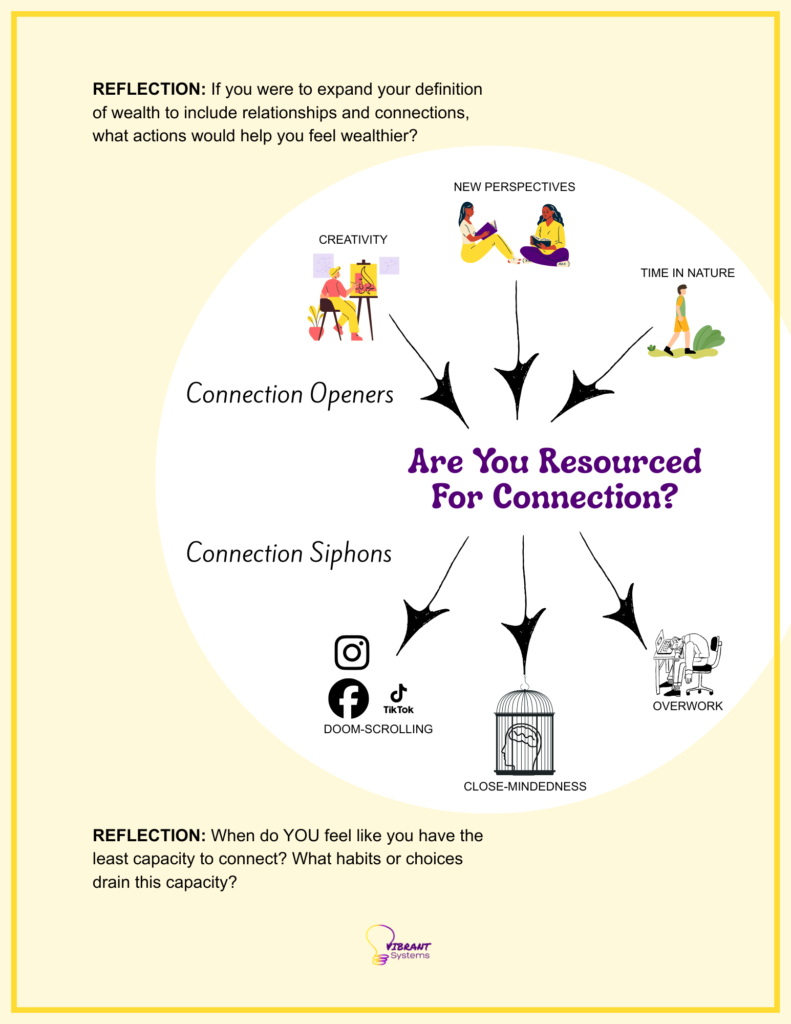
I think every single one of us will have a different answer to this question. I encourage you to answer it yourself (and if you’re called, share with us in the comments).
The biggest lesson I have learned through the turbulence of the past few years is that connections can grow when we give them time. And I get that time is in short supply. Many of us are trading our time for money, but when we aren’t doing that, are we spending our time wisely?
- Are we properly resting so we have the energy to spend with our nieces, nephews, and children?
- Are we engaging with opportunities to learn, reading new stories, and celebrating human ingenuity?
- Are we taking even just a moment to express gratitude for the food on our plates, and the countless people who have helped bring it there?
Yes, some of our time will always be dedicated to work. For many of us, that is important work that helps us build our communities and feed our families. But how do we steward the time that isn’t necessarily pencilled in? How do we use our free time to nourish ourselves, rather than numb ourselves to how much we have given already?
My name is Danielle and my mission is to help people deepen their connections to self, to others, and to the environment, because I know how empty life can become when we let those connections disintegrate. If you’re ready to make this commit with me, join my newsletter for monthly insights on what connection, change, and community can look like for you!

Comments are closed