

Our values, when we get into the meat of them, are the driving forces behind our actions. Of course, we can claim we have certain values, but our choices will always tell the truth of whether we hold them or not.
Very often, we may find ourselves hoping for a sort of future utopia, but without interrogating the actions we are using to get there.
Many of us still hold the values of the current system, and therefore, our actions each day only rebuild this system. Some of us may say we have certain priorities, but neglect the conscious work of interrogating how and when we actually allow them to shape our lives.
Values-based leadership and community-building has always been a part of the work that Vibrant Systems has done, both personally and collectively. When we don’t make these questions an active part of our organizing and growth, we simply live our lives based on the priorities we’ve been unconsciously enculturated into.
In this article, I am going to explore exactly why the visionaries of the future need to spend time articulating and embodying their values if they actually wish to make their vision tangible.
Where Do Our Values Come From
In anthropology, we understand that each one of us goes through a process of enculturation. Usually by observing our elders and the system we are raised in, we are taught what to care about, what being a good community member looks like, and how to achieve success.
However, in a largely colonial-capitalist society that has sought to eliminate or at least homogenize cultural differences, we need to acknowledge that colonial-capitalism itself has instilled values in most of us.
For just a moment, ask yourself these questions:
- What is your idea of success?
- Where did that idea of success come from?
Depending on the unique situation of our lives, our answers will vary. I know without a doubt that my expectations of success were created in me by the movies I grew up watching, and by the work ethic my parents embodied. (Note: This is just one kind of question to interrogate our values.)
When we zoom out to a systems level, it becomes clear these values are not simply family values innocuously handed from parent to child. They are actively imposed upon us by a colonial-capitalist structure that we are living within.
Which is fine if they lead you to live a life that is truly fulfilled and satisfying. But when we look at the high rates of depression, anxiety, and loneliness, one should be asking if these universal “liberal” values accurately reflect a future we want our grandchildren to inherit.
The Connection Between Values and Well-Being
You may want to dismiss the importance of values. You may want to close this article and drown out the accusation I’ve levelled against the colonial-capitalist system.
Before you do, let’s explore why our values (and how they drive our choices) are actually an essential part of human well-being.
The consequences of misaligned values

I only started on this path (blindly, not knowing where it would take me) when I found myself in a soul-deep burnout. The priorities I had in life were leading me to make certain choices. Those choices were taking a direct toll on my health.
I lived with chronic migraines that left me bedridden for several days. I experienced heavy weight gain. My sensory overload left my nervous system fried (I left an ice cream shop in tears once because the noise of metal scraping against counters was too much). I struggled to engage with friends in any meaningful way.
The pain, physically and emotionally, led me towards substance use and other behaviours that helped me block out just how… wrong… my life had become.
It was at this point in my life that I turned towards Acceptance & Commitment Therapy, desperate to find a softer way to live.
In Acceptance & Commitment Therapy, the goal is to remove judgment towards our actions and experiences, and instead reflect:
- Why did we make that choice?
- How did making that choice make us feel?
- What would we like to do differently?
Likewise, Acceptance & Commitment Therapy guides us to choose the values that are true to us. The goal is that we can start making choices based on those priorities, and eventually our lives get easier, more fulfilling, and more true to our core.
But in that moment in time, I had no fucking clue what my “true” values were. I just knew what hadn’t been working.
You see, our values drive our actions. And when we keep making choices that don’t reflect our authentic priorities, we end up feeling very unfulfilled, apathetic, or even depressed. Without awareness, we may try to fill the dissatisfaction with substances, media, or achievements, but all those things actually deepen the emptiness.
Journeying home to self with Acceptance & Commitment Therapy
After taking the time (over years and as an ongoing process) to explore my personal values, my life changed on a fundamental level. My business, Vibrant Systems, emerged out of this self-exploration. I feel more alive, more eager for the future, and more empowered to show up in my authenticity.
Our well-being in inextricably tied to our values.
This isn’t a shallow thing.
Values are what has worth. When we are consistently denying our authentic values, life path, and priorities, we are also communicating to ourselves that our authentic embodiment is not worthwhile. We are telling ourselves, through our everyday actions, that we are not worthy.
When we live inside a system that is centered around the accumulation of worth (money, resources, etc.), we are groomed into believing that worth is something that exists outside ourselves. We are led to make choices to accumulate this worth. We are taught that our own worth is contingent upon this accumulation. It makes sense that we live much of our lives prioritizing the values of the colonial-capitalist system.
But if you are like me, and these values do not reflect your internal values system, the pursuit of external worth will consistently deplete our self-worth.
Choosing to do the work to excavate our unique values from the system’s conditioning, and live a life based on the authentic truth we find–it really is the greatest story of self-love there is.
Beyond Personal Wellness and Towards Collective Well-Being
The colonial-capitalist system instills in us specific values that feed the system itself: hard work, financial security, nuclear family ties, fun, and so on. Often the values we absorb are individualistic to the point of isolation. Unless we have been exposed to other worldviews, we might never consider community as a value, let alone values that support sustainable community-building, such as restorative justice.
This isn’t to say that none of these values have a place. But our values systems are deliberately kept incomplete.
In Frantz Fanon’s Wretched of the Earth, he highlights the fact that colonized peoples have their cultural values violently stripped away through the processes of colonization. Part of the process of decolonization, he concludes, must involve the restructuring of values that are separate from the colonial system.

As a student of the decolonization movement, I am also recognizing that this restructuring of values is something each one of us can benefit from. Whether we are born from a line of colonizers or the colonized, we have been groomed to live by the values and priorities of the colonial-capitalist system.
I can look at the system that values the hoarding of wealth over the helping of neighbours, and I can see how that drives a feeling of division and scapegoating. I can see how valuing hard work and meritocracy is driving burnout, anxiety, and a reduced time spent with children. I can see how valuing resource extraction and profit over the health of the land itself is directly responsible for the global ecological collapse we are in the midst of.
Our collective well-being relies on our willingness to interrogate our values systems and to consciously choose values that are regenerative, relational, and diverse. As my teacher, Dra. Rocio Rosalez-Mesa, says we are all worthy of exploring the wounds created by this system.
Naming The Values Isn’t The End
On my Let’s Connect page, I list the values that drive Vibrant Systems. I list them to create a sense of public accountability, and radical responsibility for how I show up in the world today.
Naming what we are prioritizing means nothing if we aren’t actually prioritizing those actions.
Adrienne Maree Brown, in her book Emerging Strategy, hits the nail on the head here. She pinpoints the facts that our actions are like fractals. This means that how we speak to a coworker or our niece is going to reflected throughout our actions. Our collective actions in a system can fundamentally change that system from the bottom up. Our values, if we embody them, echo up in greater ways.
In organizational systems, this means that we need to take our values statements seriously. If I want Vibrant Systems to drive “Regenerative growth towards a sustainable future,” then I need to be aware of how my daily routines actually reflect growth, rest, balance, and sustainability.

Personally valuing playfulness or creativity means nothing if I don’t make the time to play and be creative–if I don’t SHOW how I value creativity and playfulness by investing time, energy, and resources into these things. Acceptance & Commitment Therapy doesn’t simply teach us to know what we see worth in–it holds us accountable to valuing that worth.
If an organization values inclusivity or equity, how are they actually acting every single day to ensure those values are embodied throughout their organization by all members? Are they actually inclusive if their building itself isn’t even accessible?
Values Exploration Is A Fundamental Pillar To Vibrant Systems’ Work
We can’t ignore values. Not if we actually want to shape a new future. If we don’t do the work to explore what is currently driving our actions vs what we WANT to be driving our actions, then our actions themselves may never actually change.
If our values stay unconscious, then we are drawn towards numbing the dissatisfaction that their misalignment creates. From a place of numbness, we cannot drive change.
On the other hand, when we see where the disconnect is, we are emboldened to change. Maybe that change is small at first. But as we practice stepping into our authentic values, and as we feel the power and energy that pours in from those aligned choices, it becomes nearly impossible to go backwards. People-first change management and Community Mentorship are anchored into the values of your community for this exact reason.
Every single one of us will benefit from doing this work.
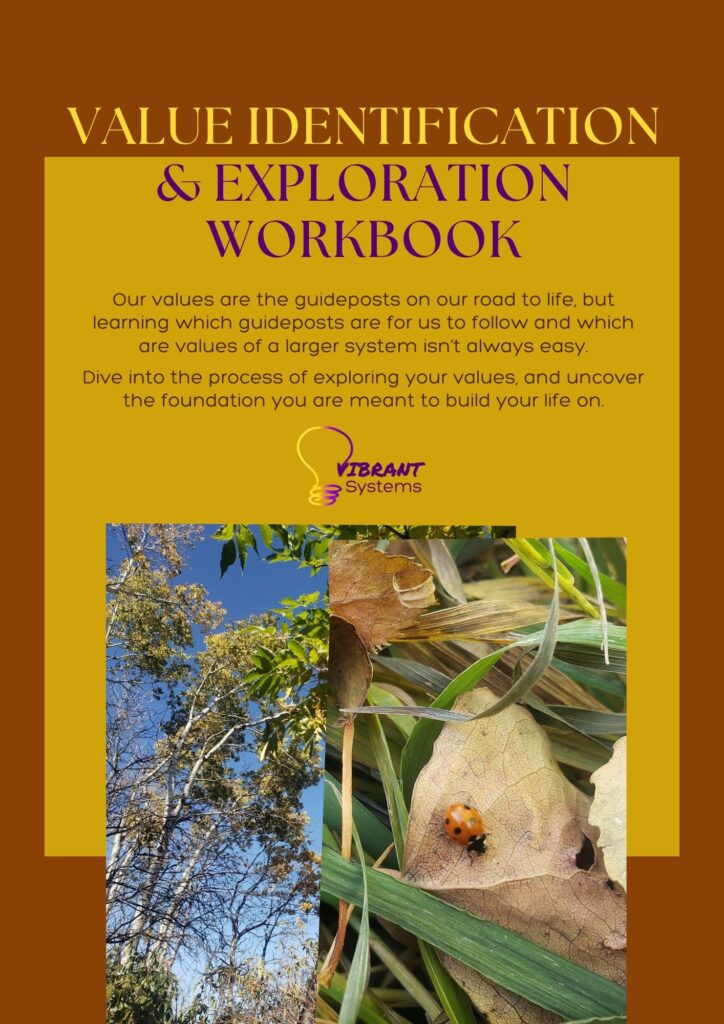
That’s why I have created the Value Identification & Exploration Workbook, and why I offer facilitated workshops to groups looking to explore their collective values more deeply (get a quote to those workshops here).
Whether you are a community-builder, a transformational leader, or just a person who is done living a life half-lived, the next step you’ve been looking for is to explore your values.
So explore those values with Vibrant Systems. Let’s make your story a vibrant one.

No responses yet